Sunday, August 25, 2013

Friday 16 August 2013 - Honolulu, Hawaii

email from mum -

Early arrival in Honolulu, we were scheduled to dock at 7am. I got up at 6am to watch us arriving and had breakfast later. Our tour did not leave till 9.15.

We were going to see Oahu's East Side and Pali Lookout where King Kamehameha I forced hundreds of opponents to jump to their death from the cliffs in 1795. This win allowed him to unite the Hawaiian island under one king.

Our tour started with a drive by Waikiki Beach. A beautiful crescent of white sand, imported from Australia! There is lso a statue of a famous surfer who was born here. We continued along this beautiful coast and enjoyed glimpses of the ocean and beaches as we went.

Our first stop was inside Diamnd Head, an extinct volcano. It got its name by British sailors in the 1800's who mistook the glittering crystals in the lava rocks for diamonds. The crater itself is huge, several km's in diameter. It is now home to many different birds and trees, some of the birds are also common in Australia. The Indian Myna Bird, a pest and very aggressive, brought in from India at some stage, and the Spotted Dove, a nice gentle pigeon. There are others too, but these I saw in several places through Hawaii. The outside edge og the crater housed several bunkers with cannons used during WWII. Not all of them pointed the right way when Hawaii was invaded!

Further along the coast we stopped to have a look at a blowhole and beach. This sandy beach is the most threacherous in Hawaii because of currents and rips, plus sharp rocks etc. that people cut themselves on and need help to shore. The Blowhole was cute, the winds were not coming in the right way for a very good display, but I think Kiama's is better on a good day.

We drove on to Ulupo Heiau a sacred site built during the 1400's as a sacrificial site and built of rocks and is flat on top. The road wound its way up to the Pali Lookout. It is a very windy place 300m above the sea. Here King Kamehameha fought his famous battle. Now there are a few dozen chooks who live here and a dozen cats. One chickenhad a couple of small chicks, another halfgrown ones. One of the cats was bit the worse for wear with a sore leg.

As we left to return to Honolulu a shower started, but by the time we reached the outskirts of town it had stopped. I arrived home for lunch and in the afternoon worked a bit more on my cross stitch. It was nice and quiet with most people on tours or out exploring on their own or shopping to boost the local economy.


Thursday 15 August 2013 - Hilo, Hawaii

email from mum -

I'll be going nuts today. I have booked a tour to a Macadamia Nut Farm. We will also visit the Akaka Falls, a waterfall plunging 422 feet (128m) straight down into a small pond below.

We had a very leisurely start to the day, arrivng in harbour at 9am. Our tour started at 10.30 and were expected to return at 2.30. No lunch, but time for afternoon coffee and a cookie. There is a 'Cookie Girl' or a 'Cookie Man' each afternoon about 3pm for those who cannot resist. So if I skip lunch and wait for a cookie or two... If I have lunch I normally have some rabbit food and skip the cookies.

At 10.15 we were all waiting in the Princess Theatre and then walking together to the bus. A lot less fuss with Customs here in Hawaii. Maybe they realised we were all thoroughly checked out in NY and LA. We were told to bring Cruise Card and photo ID in all american ports. And they were checked, but no 1 hour line up to smile at the guys.

Mauna Loa is the largest volcano on earth. If you combine the height under the sea and that above sea level it is the largest mountain, higher that Everest. It is not apples and apples, but the Hawaiians use it.

Our first port of call was Akaka falls, we had a short walk through the rainforest to reach it. A loop so we did not go back against the next lot of people coming in. It was beautiful. There was no sun, so no rainbow on the day. On top a man was cutting and shaping palm fronds into dainty birds and attaced them on sticks. It looked like they were flying.

Before arriving at the Macadamia Farm, we made a stop at a small zoo. They have a white Bengal Tiger which has been sick and is now back on display, but not very lively. He was sleeping under some trees with his back to us. There were many exotic birds including macaws. They also have miniatur goats, only 50-60cm tall and with longish hair. Very cute.The Hawaiian State Bird, the endangered Nene is also here.

At the Nut Farm we received a small cup with a few macadamia nuts. Inside they had many varieties of macadamia nuta. Standard roasted with sea salt, honey roasted, garlic and sea salt, and a few more. Of course also chocolate covered nuts! I opted for a sit down and a macadamia ice cream, very nice. Made up for lunch, it was a big serve.

After all the nuts were packed into the bus we headed for 'home' through lush rain forest. Very humid, but not too bad as the temperature was only 25-26 degrees. When we were scanned back on board, I went down to my favorite bar for a cup of coffee.

Tomorrow Honolulu.

Alaska Falls

Hilo Port

Sunday, August 11, 2013

Saturday 10 August 2013 - Los Angeles, USA

email from mum -
So we are in the city of the movies. I am going to Universal Studios to learn a bit about how they make the movies and TV series. We are a bus full with 50 passengers keen to find out their secrets.

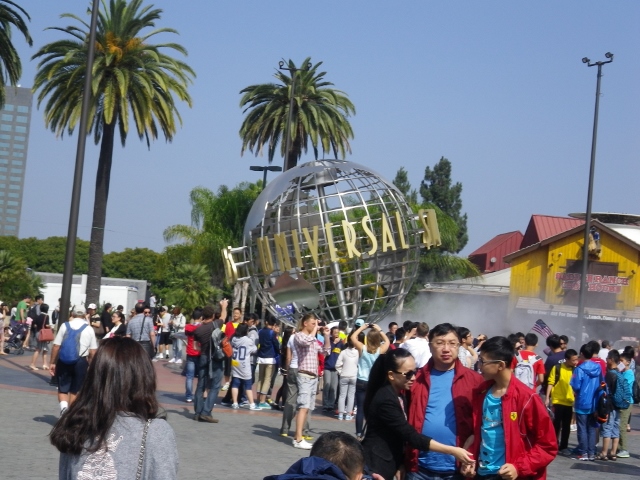
We first drive towards Los Angeles city before turning onto another freeway towards Hollywood. Yes, I saw the signs for Rodeo Drive, Sunset Boulevard, and others, We also saw the sign on the hill, but were not real close. In front of Universal they have a gobe turning around. It cost US$84 to get in, but that covers all the rides and shows.

Lorna and I decided on the Studio Tour. We were seated in a Trolleybus with open sides. The bus went past some of the houses used in 'Desperate Housewives' and some western movies, and many others that I am not familiar with. We also drove through 'King Kong' where we were attacked by dinosaurs, experienced earthquake, and a flood where some of the passengers got wet. It was all very realistic. As we came past a small dam there was a shark jumping out of the water. A bit further on we saw a man carrying a woman and put her in the booth of a car. (from the movie Psyco).

After the Studio Tour we decided on some lunch and stopped at an Italian place, Louie's Pizza and Pasta where we had beautiful Lasagne. The best I have had. We then walked around a bit checking out the souvenir shops and tried not to buy too much, but a couple of items followed us home. Later we stopped at the International Cafe for a cup of coffee.

Our next adventure was 'WaterWorld' where the 10 first rows were marked Wet Zone where it turned our the spectators got drenched from time to time. We went 2 rows further up and managed to stay dry. It was very action packed with water scooters doing sharp turns and a large wave soaked the first few rows. A couple of boats were also part of the show and people falling (jumping) from tall towers. Also and explosion where one of the towers fell over into the water.

We only had an hour left so we went outside to have a look at the Universal City Walk. Here there were more shops and cafees. After walking through we returned to where our bus would come to pick us up and saw two bridal parties, one white bride and one in hot pink. When the bus arrived it had to park a little further along and 2 couples were missing so the driver had to go back and find them, then we were off towards home.


image from google images

Wednesday, August 7, 2013

Sunday 4 August 2013 - Puntarenas, Costa Rica

email -
We arrived in Puntarenas, Costa Rica, at 5am, so an early start to the day. I usually get up around 7.30, but since the bus leaved at that time, I had to be an early bird for the day.

We met in the Vista Lounge after getting our stickers, orange 18 today. The buses were waiting on the pier after having reversed all the way out. Not enough room to turn. Our bus had come from San Jose, the capital. Our guide, Veronica, told us she left home at 4am to get to Puntarenas, a 2 hours drive.

After boarding the bus we set off for the Macaw Sanctuary 45 minutes away. All the houses were small mostly single storey. Many had a small garden with banana plants, some had mango trees, coconut trees, etc. The day we visited was Sunday and they had a holiday on the Saturday, so not many people around at this hour.

Coffee is a big export product for Costa Rica, but is grown higher up and we did not see any. The tour I had originally booked was to the Coffee Plantation, but was full so I got my 2nd choice. The roads seemed quite good, till we turned in on the way to the Sanctuary. This is a dirt road, the speed limit is 40k/hr with some sections down to 25. A school house we passed had been decorated by the students.

At the gate we were met by a flock of turkeys, Daddy Turkey with his Girls and 4 or 5 chicks. There were also 5 cats roaming around. I took a photo of a white one for Lisa. Apart from the 3 typesof macaws we also saw Ecclectic parrots, sulfurcrested cockatoos, African parrots and others. We also saw a Tapir mum and her calf, 3 weeks old. He was so cute! Mum loved carrots. She came up to the fence and we fed her a carrot each.

Many of the birds here are being rehabilitated after suffering various injuries and later released into their habitat. Some have been rescued from the black marked and cannot be let out in the wild, they may not be able to find the right type of food or nesting place, as the australian cockatoo. The Tapir was found on the black marked already pregnant and tame. A tame animal would find it very difficult in the wild.

We were also shown a Lipstick Fruit.  It was used by the local girls as lipstick or to paint their faces.
Fresh fruit grown in the area was served with a bottle of water, watermelon, pineapple and pawpaw. The shop was open and what was bought there went to help finance the Sanctuary as they have no help from the government. Our bus was waiting so we hopped on board for the journey to the boat which would take us through the protected mangrove area.

Herons and kingfishers, sandpipers and eagles were spotted, as were the crocs. We saw 4 crocodiles, but no monkeys today. Small fish were jumping in a few places, but it was too hard to tell what sort. So it was back to the ship for our next section to Los Angeles.


Mother Tapir

Baby Tapir 3 weeks old


Lipstick fruit


Friday 2 August 2013 - Panama Canal Transit

email -
So we have arrived at The Panama Camal.

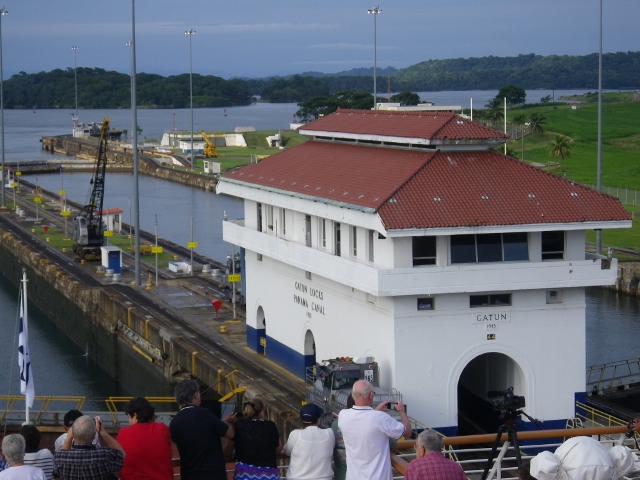
There will be no going ashore today, just hanging around the ship watching. It is quite amazing really that 99 years ago they managed to escavate and construct a canal from the Atlantic to the Pacific ocean. The canal is 80 km long and raises 26m above sea level. Each Lock is 32.3m wide and 294.1m long. The Sea Princess is just over 31m wide and 261m long so there is not much spare room, less than 50cm on each side. This is precision work.

The Mules, the locomotives, that hold the ship in the centre of the lock as we advance and wait for it to fill with water, each have 2 strong steel cables that they reel in or out as needed. Because of this the front and aft section of deck 7, Promenade deck, were closed off.

The majority of passengers were on deck 12 and 14. As we entered the lock at the low water level, I went down to deck 5 to have a look at the view, There was none! All we could see was the wall of the lock. Still there were some who enjoyed a cup of coffee down there.

It was quite an eerie feeling standing on deck and see the ship lifting. There are 2 sets of locks side by side and it was easier to see what was happening by looking at our neighbour. The lock gates are double with 3 to 4 feet between when they open they flatten against the wall in a small recess especially made for them.

So bit by bit we were raised to Gatun Lake 26 m up. That is 8 - 9 stories high. There were several ships that had just been lifted up or waiting to come down to the level of the Atlantic. One passenger near me said he had seen two crocodiles/alligators along the shore f the lake. There were many birds, pelicans and frigate birds and others. We passed under one of 2 bridges here, the Sentenial Bridge.

At the other end of Lake Gatun we entered the single Pedro Miguel lock to take us down to Lake Miraflores. From here we could se the tops of the tallest skyscrapers in Panama city down on the Pacific coast. On the top floor of the administration building there were quite a lot of people watching us and waiving.  We also needed to negotiate the 2-lock Miraflores locks to get down to the sea again. On the way out we passed under the Bridge of the Americas.

A third set of locks are being constructed at the moment at both ends of the canal, we could see some of the work as we went past. The new locks will be much larger, 366m long and 49m wide to make room for the newer ships that are too large to fit the current size locks. They will also be deeper, 18.3m against the current 12.8. They are excected to be competed next year.

Now I know why they called it the Pacific. It has been very calm overnight, no lullaby there. This morning there are only small wavelets, under a foot high.
 
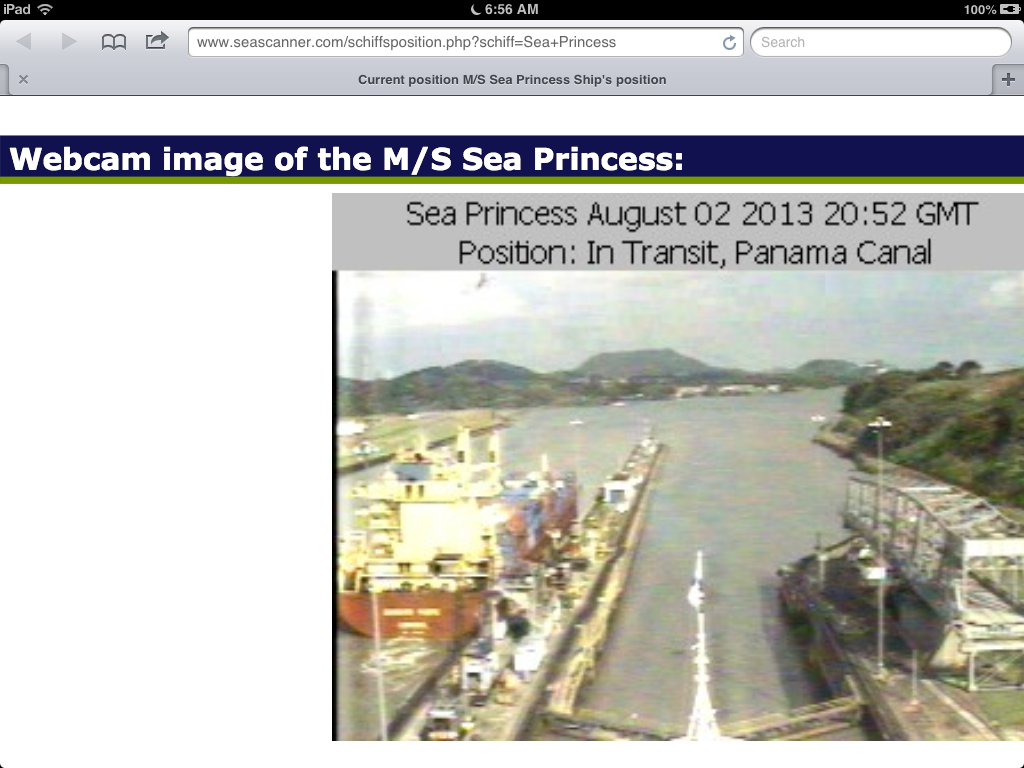
I think I got just as many pics as mum doing screen shots from the cruise cam !


entering the canal


exiting the canal


Wednesday 31 July 2013 - Curacao, Carribean

email -
Arrival in Curacao was on time, 7am. The weather was good, a promised 29 degrees and partly cloudy. A couple of those clouds gave us some brief showers while I had breakfast, but dried up in a few minutes. As I walked across the deck back to my cabin it was already dry and stayed that way during the day.

I had booked a tour to the ostrich farm, the largest outside South Africa with 600 birds. We did not leave till 12.30 so I took it easy 'at home' and had an early lunch. Most of the passengers were out on various tours or just walking into town and checking out the shops and coffee bars, so it was nice and quiet in the dining room.

We met our tour guide on the pier, when we were all there she guidd us to the bus. The driver was again a lady driver, she did the job well too. There were many narrow roads and tight corners, a couple of times she had to make a 3-point turn around corners. The drive to the farm went first over the 'New Bridge" the highest in the Caribbean to allow ships in to the inside port. Sometimes the cruise ships needed to go in there to turn if they were tied up in the channel. The Old Bridge is a pontoon bridge and swings away when ships need to go in or out.

On the way we saw many of the typical caribbean houses, all painted in various colours trimmed with white. There are 4 official languages in Curacao and Aruba too, Dutch, the main one, then English, Spanish and also Papiamento a mix of Spanish, Portugese, Dutch, French, English and Arawak' The first inhabitants of the islands were Arawak indians from South America. The Spanish arrived in 1499 and the Dutch in 1634.

At the Ostrich Farm we boarded a safari jeep (electrically driven) for a tour of the pens to see the birds. The males are black and white and the females grey and white. The young chicks are grey all over. A female can lay as many as 80 eggs in a season. The males look after the eggs and hatch them and is also looking after the babies. The farm has an ncubator so they remove the eggs from Daddy and after a couple of weeks he goes looking for female company again.

Ostriches are very good at kicking, forward only. They do not bite much as their beak is rounded in front. I could feed them with my hand open flat with some pellets on, they did not bite or pinch my fingers till the pellets were gone, then I got pinched! There were a couple of miniature horses in a pen near the house. We saw a few iguanas around the yard as well as geese and ducks. Ostrich eggs are very strong, we were standing on one to show how strong they are. I have a photo to prove it.

After looking through the shop we boarded the bus for a short trip to Chichi's a gallery nearby with crafts and figures painted by many of the local ladies. A couple of the smaller ones are now on board the Sea Princess.

As soon as we were all onboard, we set off for the Panama Canal. We will have another day at sea before arriving there.


Standing on the egg


 Aloe Vera farm
 
 Iguana


Monday, July 29, 2013

Tuesday 30 July 2013 - Aruba, Carribean

We had meant to be in Antigua for Monday 29 July howeve due to bad weather they decided we would miss that port and have an extra stop in Aruba.

SMS - Mon 29 July
I have booked a tour on a semi sub surface vessel but have been advised I am on the waiting list so we shall see.  I will look for a second option.  Sea is a bit rough but we are using the stabilisers so not too bad.  I made the 3rd round of bowls today and 2nd in the bean bag toss.

email -
We arrived in Aruba 2,5 hours ahead of schedule. I woke as I heard the engine 'change gears' and looked out in the dark at 4.30am and could only see a row of lights in the distance. We had arrived. We were due to arrive at 8am. By 5.30 we were tied up.

Aruba is one of the three ABC islands in the southern Carribbean. The others are Bonaire, the smallest, and Curacao, the largest, which we will visit tomorrow. Aruba is 36km long and is quite close to Venezuela. On a clear day, you can see Venezuela from Jamanota, the highest point on Aruba, 188 m high in the south of the island.

I had booked a tour to see the shipwreck o at 400ft long.f the German Antilla, one of the largest shipwrecks in the Carribean. It was sunk (porposely by the captain) early during the war. The captain after delivering his cargo did not want to return to Germany because the war had started. Approaching Aruba he fired up the boilers and the made a hole so the water came in and the whole thing blew up. The captain was the last one to leave the ship! Unlike the 'Chicken of the Sea' the captain of the Costa who stumbled and fell into the lifeboat ? !

I was originally put on a waiting list for this, but during the last couple of days they had over 20 waiting and managed to organise and afternoon tour and we all got on, all 27 of us.

The driver took us along the 'hotel strip' towards the north of the island. There are two main areas, low level, up to 5 stories, and a bit further north 5 and above. At Malmok Beach we boarded a small ferry to take us to the sub above the Antilla. We were herded downstairs into the viewing area, ca 1.8m wide with windows on both sides and seats where we could look out and admire the life on the outside.

The sub sailed above the wreck, back and forth so we could see on both sides. So much fish, but only small ones. The largest were dark blue with electric blue edge on their tailfin and a yellow spot near the tail, ca 15cm long. There were also striped fish about 8 - 10cm and hundreds of what looked like baby sardines, 2-3cm, they were everywhere. There were also some quite large 2-legged fish!! 5-6feet long I think.

It was amazing to see the wreck itself. It rests in 55 feet (18meters) of water laying on its side, but the top side is only a couple of meters under water and easily accessible and very popular with divers. On the way back to land we saw some turtles. They were swimming on the surface, but as soon as we got close, they dived and I could not get a photo of them.

Our next stop was the California Lighthouse located on a hill near the northern point of Aruba. It was named after the steamship California which sank just north of the island. The lighthouse was buit in 1910, but is no longer manned since it has been made automatic. The Keepers cottage has been converted into an Italian restaurant, popular for weddings.

We turned our bus southwest towards the centre of Aruba to view the Casibari Rocks, large boulders, some as large as houses. Quite amazing in the middle of a landscape mostly flat with almost desert like small scrubs and dry sparse grass.

Further west we came to the Baby Natural Bridge, the only remaining since the large one collapsed some years ago in the middle of the night. Thank heavens it was not during the day when the tourists were there walking across. We also could see along the road some lava rocks under a half metre layer of coral, a sign that Aruba has likely been mostly under water many thousands of years ago. The beaches which are all public, not reserved for the hotels along the coast, are made of white coral dust and does not get hot like normal sand because coral does not absorb the heat.

We returned home just in time for dinner. Tomorrow we will visit Curacao.


Coconuts
 
 Fish from under boat